Island Pacific Retail Software in 2026: Platform, Deployment and Pricing
If you are evaluating Island Pacific, you are probably trying to establish whether a company that has been in this market since 1977 is still building current software. This page answers that with specifics: the platforms, the deployment options, the integration architecture, what an implementation and an upgrade actually involve, and how the software is priced.
The short answer: Island Pacific has built merchandising software for fashion, apparel, footwear and specialty retailers since 1977, and it is still building it. Retail Robot launched in 2025 as a cloud platform for agentic commerce. SmartSuite integrates Stripe for payments and Workday for financials and workforce. The integration architecture has been service-oriented since 2005 and now extends to Model Context Protocol for working with AI agents.
Long tenure in one industry is why the software handles size, color, season and allocation the way retailers in this category need. It is not a reason to assume the product stopped moving.
Is Island Pacific's retail software outdated?
No. Island Pacific launched Retail Robot in 2025, a cloud platform built for agentic commerce. Its merchandising platform integrates with Stripe for payments and with Workday Financial Management and Workday Human Capital Management. Its integration architecture has been service-oriented since 2005 and now extends to Model Context Protocol for AI agents. The company has been building retail merchandising software since 1977, which is 49 years in one category rather than a product that stopped.
The question is a fair one to ask of any vendor with a long history, and it deserves an answer made of dates and specifics rather than adjectives. The rest of this page is that answer.
What is SmartSuite, and what is Retail Robot?
SmartSuite is Island Pacific's merchandising and retail operations platform for fashion, apparel, footwear and specialty retailers. It covers:
Merchandise planning, with SmartPlanning as the planning module
Inventory management, including inventory visibility across stores, warehouses and digital channels
Omnichannel retail, coordinating stores, warehouses and online
Each of those has its own page setting out what it covers. Island Pacific has had a planning product as a core part of merchandising since 1997.
Retail Robot is a separate platform, launched in 2025, built for agentic commerce and sold as cloud software. It covers point of sale, inventory, analytics and multi-location operation.
SmartSuite is a merchandise management system, not an ERP. Point of sale connects into it rather than leading it.
Is Island Pacific cloud or on-premise?
Both options are available, and the choice depends on what a retailer needs.
SmartSuite deploys on-premise or in the cloud. The applications are modular, their components are chosen to fit the job each one does, and they run across multiple IBM Power platforms, on Windows, and in a range of cloud configurations. On-premise remains available. That flexibility is why the same platform runs for a mid-size specialty chain and for a retailer operating at international scale.
Retail Robot is cloud software only, sold as SaaS.
Settling the deployment question during scoping
Deployment affects both the implementation timeline and the ongoing cost of running the system, so it is worth settling early rather than late. Three questions decide it in most evaluations:
What infrastructure do you already run, and who maintains it?
Where does your data need to sit, and what governs that?
Who carries responsibility for the environment once the system is live?
Bring the answers to a scoping conversation and the deployment recommendation follows from them rather than from a default.
Does Island Pacific integrate with other systems?
Island Pacific adopted a service-oriented architecture for system integrations in 2005 and has worked that way since. That architecture now extends to Model Context Protocol, so AI agents can operate across the systems a retailer already runs.
Current integrations
Stripe. Island Pacific integrates Stripe's payment infrastructure across online, mobile and in-store payments. Payments taken at the till, on the site and in the app report into the same merchandising and inventory record.
Workday. Island Pacific integrates with Workday Financial Management and Workday Human Capital Management. Island Pacific runs merchandising, buying, planning, inventory, order management and pricing. Workday runs the financials and the workforce. The two systems connect rather than overlap.
Both integrations, and the other systems Island Pacific works alongside, are set out on the partners and integrations page.
The integration architecture
A service-oriented architecture means integrations are built on a consistent pattern rather than as point-to-point connections that accumulate over time. For a retailer working out how Island Pacific fits alongside systems already in place, that pattern matters more than a list of named connectors, because it determines how a new integration gets added and how it holds up as the business changes.
The useful question for a scoping call is which specific systems need to connect, and by what route, so the answer is concrete rather than general.
How long does an Island Pacific implementation take?
A mid-size chain takes four to six months. The variable that moves that range most is the source and quality of the data being migrated, which is usually known before a project starts.
FastPlan: the route for smaller retailers
FastPlan is the templated implementation route into Island Pacific's planning product for small and mid-size retailers. It takes at most three to six months, depending on the source and quality of the data being migrated, and uses the same core planning technology as enterprise deployments, delivered as a prescribed best-practice configuration rather than a bespoke build.
The difference between FastPlan and a full enterprise implementation is scope and method rather than the underlying technology. FastPlan covers merchandise, store and key item planning against a prescribed configuration. An enterprise implementation is built from a retailer's own requirements, across whichever modules it runs.
What extends a timeline
Data quality
The most common reason implementations run longer than projected. Fragmented historical data, inconsistent product hierarchies and unmapped location records all need resolving before migration.
Scope changes
Where modules or integration requirements are added after the project starts.
Customization
Where bespoke development adds time. The upgrade remediation program exists partly to reduce this over successive cycles.
How much does Island Pacific cost?
Island Pacific prices SmartSuite by the modules a retailer runs and by how it is deployed. Two variables move the figure further than any other: the number of locations and the number of users.
Planning for a chain of under fifty stores with a handful of planners is a different commitment from a merchandising, planning, inventory and order management build across hundreds of locations and hundreds of users. Cost estimates that quote a single range usually describe the second case without saying so, which is why they look alarming to a retailer who would be buying the first.
SmartSuite at larger scale
For SmartSuite across a larger operation, pricing is quoted against scope. The variables that matter:
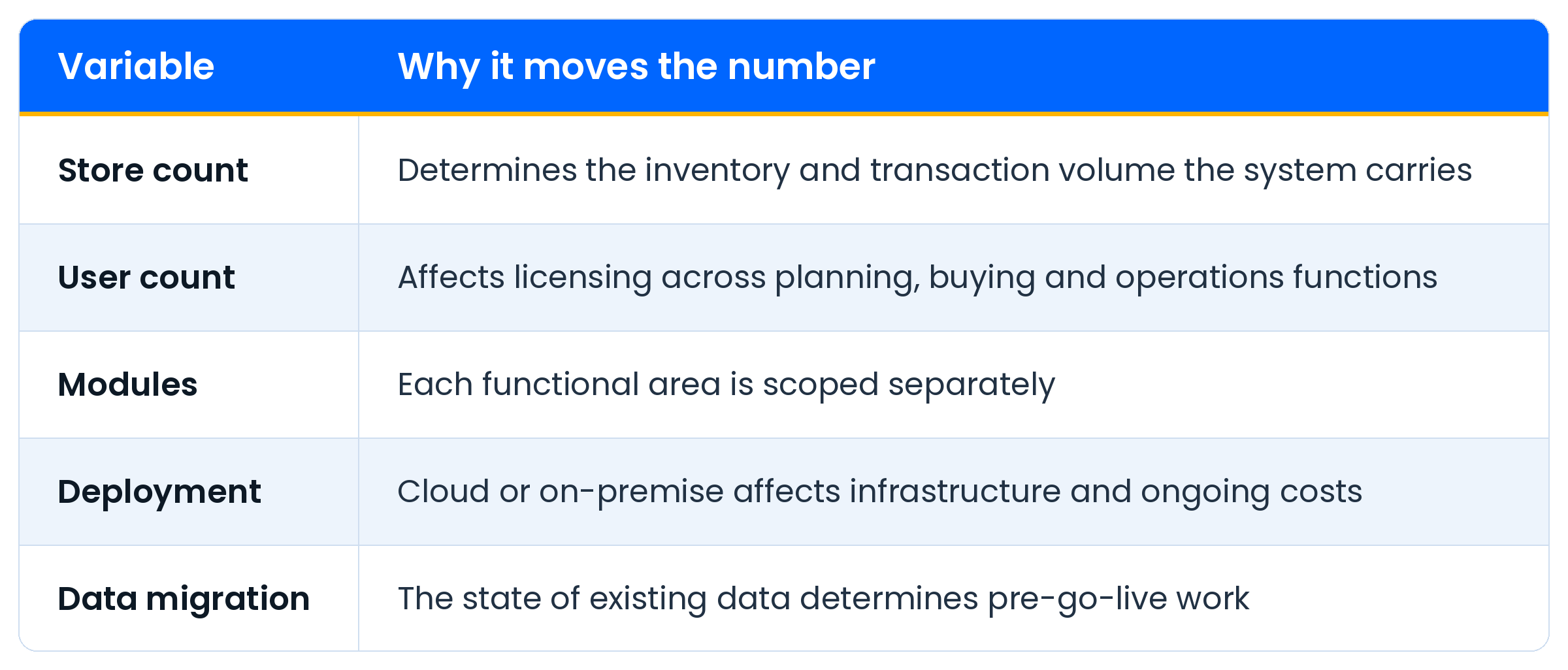
A retailer with a defined store count, user count and module list gets a scoped number rather than a range.
Retail Robot is cloud software, sold as SaaS.
How do Island Pacific upgrades work?
Customers can upgrade as often as twice a year, and most upgrade annually to stay current with new functionality. An upgrade takes one to four months.
Customization built up over years can extend that. Island Pacific runs a fixed-fee program that analyzes and remediates existing modifications as part of the upgrade, including moving custom code into the service-oriented architecture so that later upgrades get simpler rather than harder.
What the upgrade cycle means in practice
A retailer that has been on the platform for several years and accumulated bespoke development is not locked into an increasingly difficult upgrade path. The remediation program treats that accumulated customization as a known quantity, prices it as a fixed engagement, and moves it into the architecture so the next upgrade does not inherit the same problem.
What has Island Pacific shipped recently?
Retail Robot, 2025. A cloud retail platform built for agentic commerce, covering point of sale, inventory, analytics and multi-location operation. Sold as SaaS.
Model Context Protocol support. The service-oriented integration architecture now extends to MCP, so AI agents can operate across a retailer's connected systems.
The Stripe partnership. Island Pacific integrates Stripe's payment infrastructure across online, mobile and in-store payments.
The Workday integration. Island Pacific integrates with Workday Financial Management and Workday Human Capital Management.
Four additions in the period a buyer is most likely to be researching, with dates attached to each.
Frequently Asked Questions
-
Island Pacific is an autonomously run organization within the Constellation Software portfolio. Its technology investment and its product roadmap are its own, set by Island Pacific and independent of Constellation and its affiliates.
The question behind this one is usually whether the software is still being invested in. The shipping record answers it: Retail Robot in 2025, the Stripe integration, the Workday integration, and MCP support in the integration layer.
-
Island Pacific was founded in 1977 and has built retail merchandising software for fashion and specialty retailers for 49 years. The planning product has been a core part of merchandising since 1997.
Tenure in one category means the software has been through decades of problems that only appear at scale, from matrix inventory across size and color to markdown behavior across a season. What 49 years in fashion and apparel merchandising built sets out the rest, including the retailers who grew on the platform.
What the years did not buy is set out above. The deployment options, the integration architecture and the 2025 platform are current, not inherited.
-
Primark, American Eagle and Urban Outfitters are Island Pacific customers, operating at national and international scale in the categories the software was built for. Urban Outfitters grew on Island Pacific from three stores to more than 800, set out in full alongside Island Pacific's track record in fashion and apparel merchandising.
-
Island Pacific is not a full ERP. What it does and does not cover is set out separately, and it is worth reading before a scoping call if the ERP question is live in your evaluation.
Get a scoped figure
Most of what a buyer wants to know at this stage depends on their own numbers. Bring four things to a scoping call and you will get a scoped figure and an implementation estimate rather than a range:
1. Store count, current and planned
2. User count, across planning, buying and operations
3. Modules, the functional areas you need covered
4. Data state, how your current data is structured and where it lives
Working out whether a phased move is right for you?
Bring the shortlist criteria above and we will walk through them against your own assortment, including which functions could move first and what stays where it is.